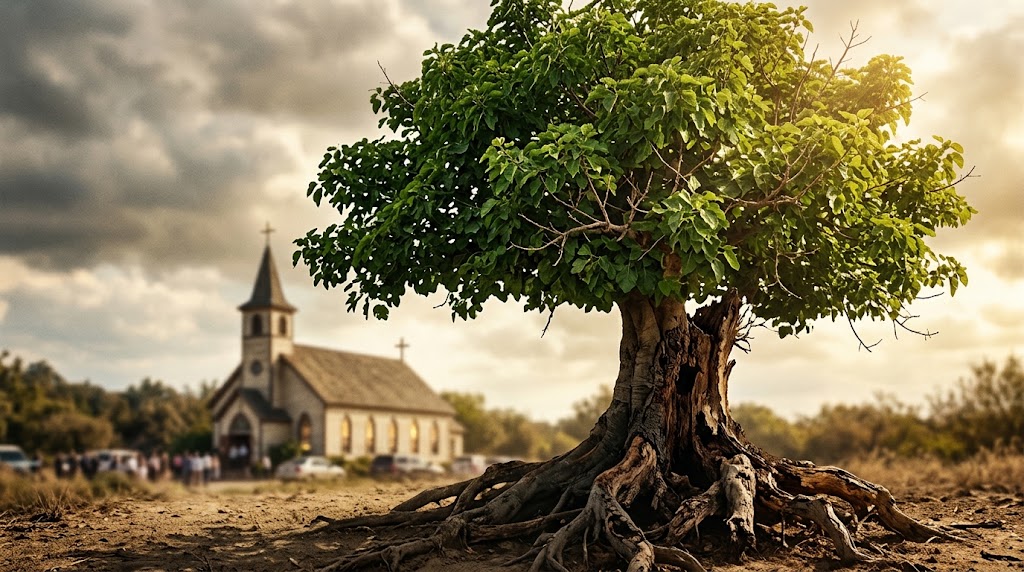
Something in Mark 11 caught my attention recently, and I can't shake it. I knew the story of Jesus cursing the fig tree and the story of Jesus overturning the tables in the temple. What I hadn't noticed was how Mark tells them. He doesn't tell them one after the other. He wraps one inside the other.
Mark starts the fig tree story, stops in the middle, walks us into the temple, and then brings us back to the tree the next morning. That is no accident. Mark is telling us that we cannot understand the tree without the temple, and we cannot understand the temple without the tree.
Once you see it, you can't unsee it. Mark isn't just asking about a tree and a building from two thousand years ago. It's a question about your church, and it's a question about you.
1. A Tree That Advertised Fruit
"Now the next day, when they had come out from Bethany, He was hungry. And seeing from afar a fig tree having leaves, He went to see if perhaps He would find something on it. When He came to it, He found nothing but leaves, for it was not the season for figs. In response Jesus said to it, 'Let no one eat fruit from you ever again.' And His disciples heard it." — Mark 11:12–14 (NKJV)
Most readers stumble over the last line of verse 13: "for it was not the season for figs." It sounds unfair. Why would Jesus curse a tree for not bearing fruit when it wasn't fruit season?
The answer lies in how fig trees grow in Israel. A fig tree doesn't wait until it's covered in leaves to start producing. Small, green early figs, sometimes called paggim, form on the branches early in the year and develop alongside the leaves as the tree fills out. They aren't the sweet, ripe figs of the main harvest, which comes later. They are edible, though, and hungry travelers along the road would eat them.
So a fig tree in full leaf announces something. Leaves signal there's fruit here, or at least fruit on the way. A tree with a full canopy and no early figs at all would not bear fruit that year. When Mark says it wasn't the season for figs, he means the season for the ripe harvest. Jesus wasn't expecting the impossible. He was expecting what the leaves promised.
That's the whole problem. The tree wasn't guilty of being bare. A bare tree in spring is honest. This tree was guilty of looking fruitful from a distance and being empty up close.
2. Then Mark Walks Us Into the Temple
Straight from the tree, Jesus enters Jerusalem and the temple. He drives out those buying and selling, overturns the tables of the money changers and the seats of those selling doves, and won't let anyone carry goods through the temple. Then He tells them why:
"Is it not written, 'My house shall be called a house of prayer for all nations'? But you have made it a 'den of thieves.'" — Mark 11:17 (NKJV)
Jesus is quoting the prophets, Isaiah 56:7 and Jeremiah 7:11.
Now look at that temple through the lens of the tree. From a distance, it had everything: crowds, sacrifices, priests on duty, worshipers pouring into Jerusalem for the Passover season, money changing hands, animals for sale, and a full calendar of religious activity. Leaves were everywhere.
But when Jesus came close, looking for the thing God built that house for, He found nothing. It was supposed to be a house of prayer. It had become a marketplace. It was busy, organized, profitable, and religious, yet it wasn't praying.
Notice where Jesus got the phrase "den of thieves." Jeremiah 7 is a sermon preached at the temple gate to people who believed the building itself would protect them, no matter how they lived. They trusted the structure. They didn't seek the God it was built for. I don't think it's a coincidence that Jesus reached for that chapter.
3. The Roots Went First
"Now in the morning, as they passed by, they saw the fig tree dried up from the roots. And Peter, remembering, said to Him, 'Rabbi, look! The fig tree which You cursed has withered away.'" — Mark 11:20–21 (NKJV)
It dried up from the roots. Mark doesn't say the leaves fell first. The death started underground, where no one could see it.
That's how churches die, too. A church rarely dies at the leaves. The calendar stays full long after the prayer meeting is gone. The building stays clean, and the music stays good. The leaves are the last to go, which is exactly why so few people notice the dying until it's done.
And the tree was a preview. In AD 70, roughly forty years later, the Romans destroyed that temple. The house that looked the most alive from a distance didn't survive the generation that turned it into a marketplace.
4. What Leaves Look Like Today
Let me be careful here, because leaves aren't sin. A fig tree is supposed to have leaves. A good building, a strong worship team, a full calendar, and a welcoming lobby aren't the problem. The question is whether the leaves are announcing fruit that's actually there.
Here are some leaves we often mistake for fruit:
- A full calendar of events
- Excellent production on Sunday morning
- Strong attendance and growing numbers
- A congregation that leaves feeling good
And here is the fruit Jesus walks up looking for:
- Prayer that is real, regular, and costly
- Genuine repentance
- Lives that are actually being changed
- Ministry that reaches past the walls to the lost, the hurting, and the overlooked
A church can slowly become a bless-me club, and we need to call it what it is. People come to be fed, served, encouraged, and entertained, and they go home feeling good without ever getting on their faces before God. The worship is judged by how it made us feel. The sermon is judged by whether it lifted us up. The prayer meeting is the emptiest room in the building, if it still exists at all. We complain when the service runs ten minutes long, yet many of us haven't wept over a lost soul in years. That isn't a house of prayer. It's a religious service industry with a cross on the roof. It's exactly what Jesus found in the temple: a house built for God, rearranged around what the people wanted from it. That church may never close its doors. It may even grow. But don't mistake a full parking lot for God's approval. The temple was full, too. Jesus will walk up to that church hungry, find nothing but leaves, and the withering will start where no one is looking: at the roots.
5. Leaves Can Fool Everyone but Jesus
Jesus said something in the Sermon on the Mount that should keep all of us honest:
"Many will say to Me in that day, 'Lord, Lord, have we not prophesied in Your name, cast out demons in Your name, and done many wonders in Your name?' And then I will declare to them, 'I never knew you; depart from Me, you who practice lawlessness!'" — Matthew 7:22–23 (NKJV)
Look at what those people point to: prophecy, deliverance, and wonders, all done in His name. Those are impressive leaves, and they're ministry leaves at that. But Jesus doesn't answer with a list of their activities. He answers with a relationship that never existed: "I never knew you."
Leaves can fool a congregation. They can fool a visitor, a denomination, and even the person wearing them. They cannot fool the One who comes close.
The Call to Action
This week, I want you to do two inspections, and I want you to do them honestly.
Inspect your own life.
- If Jesus walked up close to your life this week, past the attendance and the Christian vocabulary, what would He find on the branches?
- When did you last pray when no one was watching, and nothing was on the line?
- Is anything in you actually changing, or is it just getting more polished?
Inspect your church.
- If prayer stopped tomorrow, how long would it take anyone to notice?
- Is your church mostly a place people come to receive, or a place that sends people out to serve?
- Is all the activity producing changed lives, or just more activity?
Don't answer too quickly. Leaves are easy to point to and easy to hide behind. But remember what Mark wants you to remember: Jesus still walks up to trees hungry, and He still looks past the leaves. The tree that looked the most alive from the road is the one that died from the roots.