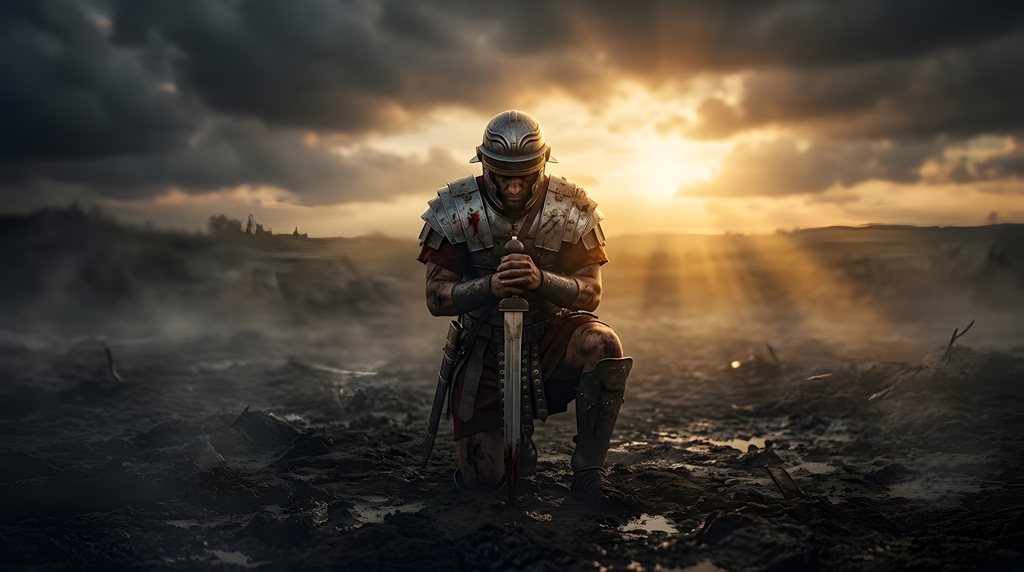
Say the words "Armor of God," and most of us picture the same thing. A warrior charging the line. Sword up, shield forward, advancing on the enemy, conquering ground. It's a stirring image. It's also not the one Paul gives us.
Read the passage slowly, and you'll notice that the command Paul keeps repeating is not "conquer." It's "stand."
"Therefore take up the whole armor of God, that you may be able to withstand in the evil day, and having done all, to stand." — Ephesians 6:13 (NKJV)
He says it again in verse 11, "that you may be able to stand against the wiles of the devil," and once more in verse 14, "Stand therefore." Three times in four verses. The goal of the fully armed believer is not to overrun the enemy. It is to remain on your feet when the evil day has done its worst. Standing is the victory.
That raises the real question. If the goal is to stand, what actually keeps you standing? And that's where most teaching on this passage stops, one verse too soon.
The Piece That Isn't a Piece
Paul lists the armor carefully. The belt of truth. The breastplate of righteousness. The gospel of peace, fitted to the feet. The shield of faith. The helmet of salvation. The sword of the Spirit, which is the Word of God. That's six pieces, verses 14 through 17. And then, at verse 18, you keep waiting for the seventh. It never comes. Instead, Paul shifts:
"praying always with all prayer and supplication in the Spirit, being watchful to this end with all perseverance and supplication for all the saints." — Ephesians 6:18 (NKJV)
Notice what he did not do. He did not say, "and seventh, take up the prayer of the Spirit." Prayer is not on the rack with the other pieces. Prayer is the air in which the armor is worn. It is the manner in which you stand armed. Strap on all six pieces and never pray, and here is the hard truth: you can be fully dressed and still not be standing, because the strength was never yours to begin with. Go back to where Paul starts the whole passage.
"be strong in the Lord and in the power of His might." — Ephesians 6:10 (NKJV)
Be strong in the Lord. That's borrowed strength, power on loan, and prayer is how you keep drawing on it. Without prayer, the armor is real, but the soldier has no power to hold the line. To see why that matters, you have to see what this armor actually is and whose it is.
Whose Armor Is This?
Look at what Paul calls it. Twice, in verses 11 and 13, it is "the Armor of God." Not armor we manufacture. Not gear we forge from our own discipline and willpower. It is His.
That phrase has a history. Centuries before Paul, Isaiah watched God Himself put on the very pieces that Paul later hands to us.
"For He put on righteousness as a breastplate, and a helmet of salvation on His head." — Isaiah 59:17 (NKJV)
The breastplate and the helmet were God's armor first. When we put them on, we are putting on what belongs to Him, sized and supplied by Him. This is spiritual armor, given by God and activated by faith. And that is exactly why prayer activates it, because prayer is the language of faith. The armor is His. The strength is His. The standing is His to give. Our part is to put it on and keep breathing faith over it.
And because it is God's armor, given by a God who knows you completely, there is something here that most people walk right past.
Armor That Fits
The God who hands you this armor is not a quartermaster handing out one-size-fits-all gear. He knows you down to the details.
"But the very hairs of your head are all numbered." — Matthew 10:30 (NKJV)
He fits the armor to the walk He called you to. That means you cannot stand in someone else's set. There's a scene in David's story that illustrates this better than any explanation.
Before David faced Goliath, King Saul tried to dress him for the fight in Saul's own armor. David put it on, took a few steps, and stopped.
"So David took them off." — 1 Samuel 17:39 (NKJV)
The verse just before it explains why. David said he could not go into battle wearing them because he had not tested them. The armor was not his. It was built for a bigger man and a different kind of battle, and David knew that walking into combat in gear he had never tested would get him killed. So he took it off, picked up the sling he had tested, and went as himself. And he lived.
Sit with that because it runs counter to how we usually think. David did not survive by wearing the impressive armor. He survived by refusing it. When you try to carry another believer's calling, fight another believer's battle, or stand in a walk God never fitted you for, the armor doesn't fit, and you will not be able to stand in it for long. You were made to walk your walk, in the armor sized for you.
Prayer Works the Armor
So bring it back to where we started. Even perfectly fitted armor, even God's own armor, hangs lifeless without one thing. Prayer is what makes it work. Faith activates every piece, and prayer is faith breathing.
Watch what Paul does the moment after he finishes describing the armor. He asks for prayer, for himself.
"and for me, that utterance may be given to me, that I may open my mouth boldly to make known the mystery of the gospel, for which I am an ambassador in chains." — Ephesians 6:19-20 (NKJV)
The great apostle, fully instructed in the armor he just described, is in prison for the gospel, yet turns and asks the church to pray for him. Even Paul does not stand alone, nor does he stand in silence. The armor and the asking go together.
So here is the word for you if you are tired, deep in the walk, and simply trying not to fall. You do not have to win today. You have to stand. And you do not stand by gritting your teeth harder. You stand by praying, by breathing faith over the armor God fitted to you, in the walk that is yours to walk. To be still on your feet at the end of the evil day is not a small thing. It is the exact victory Paul promised.
Stand therefore.