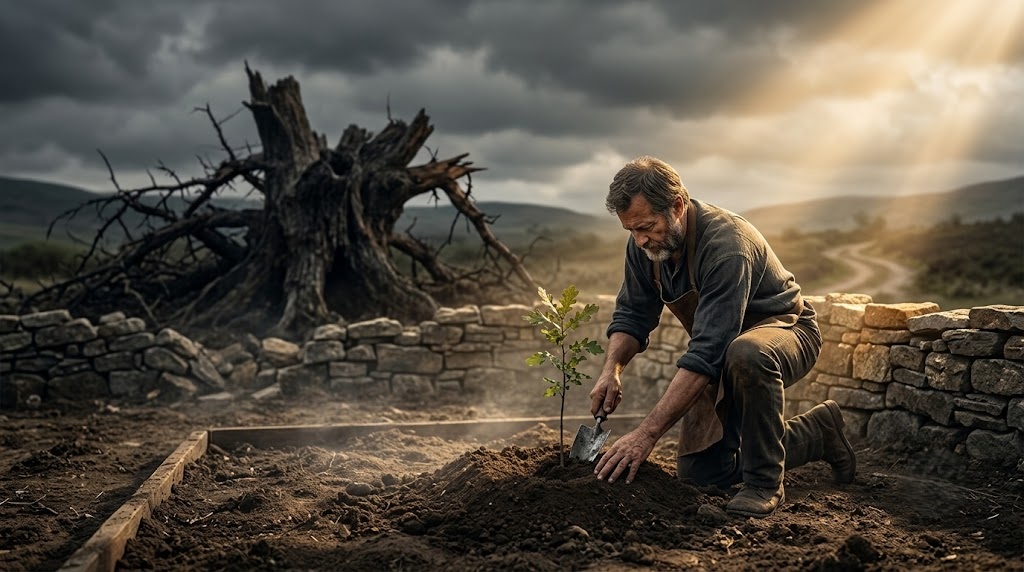
This is the companion to "The Sins of the Father: When the Old Pattern Outlives the Fresh Word." That post was about tearing something down, the inherited sin that must be named and broken. This one is about what you build in its place, because breaking a curse and building a legacy are not the same work, and the latter is the longer of the two.
The second commandment carries both a threat and a promise in the same breath. We spent the last post on the threat, "visiting the iniquity of the fathers on the children to the third and the fourth generation" (Exodus 20:5, ESV). But God does not end the sentence there. He keeps talking, and the second half is where the hope lives:
"but showing steadfast love to thousands of those who love me and keep my commandments." — Exodus 20:6 (ESV)
Read the two halves side by side. Iniquity reaches to the third and fourth generations. Steadfast love reaches to thousands. The blessing outlasts the curse by a distance we cannot measure. That is not a footnote to the warning. It is the whole point. If a pattern of sin can travel down a family line, so can a pattern of faithfulness, and the God who allows the first is far more eager to accomplish the second. The first post left you with the question of how to stop what your father passed down. This post answers the question of what to hand your children in its place.
1. Steadfast Love Travels Farther Than Sin
Notice what God ties the promise to. He does not say steadfast love comes automatically to thousands, to anyone born into the right family. He says it comes "to thousands of those who love me and keep my commandments" (Exodus 20:6, ESV). The blessing runs down a line, but it runs down a line of love and obedience. It is both inherited and chosen. A father can set the direction, but each generation still has to say yes to the God its father loved.
This should correct a lazy hope some of us carry that if we get ourselves right, our children are automatically covered. The covenant does not work like a bank account our kids inherit without lifting a finger. What we hand down is not a guaranteed outcome. It is a direction, a set of habits, a picture of what it looks like to love God, pressed so deeply into a child that it feels like home. God does the securing. Our part is to make the way of the Lord familiar.
2. The Same Abraham Passed Down Both
Here is what should sober every father who read the first post and felt its weight. The man who passed the lie down to Isaac is the same man God pointed to as the model father who trains his household in righteousness. Both are true of Abraham. God said of him, "I have chosen him, that he may command his children and his household after him to keep the way of the LORD by doing righteousness and justice" (Genesis 18:19, ESV).
Sit with that. The father who transmitted the fear that ruled him also passed down a faith worth choosing him. The lie reached Isaac in Gerar. But so did the covenant, so did the altar, so did a God who spoke. You are not only passing down your worst pattern. You are passing down your best one too, often to the same child, in the same house, at the same time. This is grace for the father discouraged by his own failures. Your sin is not the only thing your children will inherit from you. It may not even be the strongest. Abraham proves that a flawed man can still command his household to keep the way of the Lord, because commanding is not about being without sin. It is about pointing, relentlessly, at the God who is.
3. Legacy Is Built in the Ordinary Hours
If the first post warned against treating a broken curse like a light switch, this one warns against treating a built legacy like a lightning strike. We imagine the moment that turns a family, the dramatic altar, the one great conversation. Scripture points to something far less impressive. It points to the ordinary day, repeated.
"You shall teach them diligently to your children, and shall talk of them when you sit in your house, and when you walk by the way, and when you lie down, and when you rise." — Deuteronomy 6:7 (ESV)
Look at the times God lists. Sitting in the house. Walking down the road. Lying down. Getting up. That is not a special service. That is Tuesday. That is the drive to school, the dinner table, the last word before the light goes off, the first word after the alarm. A godly line is not built in the highlight reel. It is built in the footage no one keeps. The word "diligently" in that verse carries the sense of sharpening, of driving something in by repetition until it holds an edge. You are not looking for one perfect moment. You are looking for a thousand unremarkable ones, and the promise attached to that patient work reaches, fittingly, to thousands.
4. Stand Over Them Before the Enemy Arrives
The first post pointed to Job standing over his children in prayer, and it is worth returning to him here because he is the clearest picture in Scripture of a father building a legacy on purpose. Scripture says he rose early and offered sacrifices for each of his children, reasoning, "It may be that my children have sinned," and it adds that "Job did continually" (Job 1:5, ESV).
That word "continually" captures the whole legacy in a single term. Job was not reacting to a crisis. There is no report that his children had done anything wrong. He stood over them in prayer before the enemy ever got near, as a settled habit of his life, just as he rose early every morning. This is the posture of a father who builds rather than merely repairs. The father breaking a curse fights a fire already burning in his own house. The father building a legacy stands watch over a house that is not yet on fire and keeps standing there. Both are needed. But the second reaches to thousands because it is aimed not at the sin in front of you but at the generations behind it.
5. What You Build Outlives What You Break
Bring the two posts together, and you have the whole assignment. Breaking the curse is defensive work. It clears the ground. But cleared ground left alone does not stay clear; it simply grows the next weed. Something has to be planted. If all you ever do is break what your father handed you, you leave your children an empty lot. The command is not only to stop the sin. It is to build the faith, to put something in your children's hands so solid that it becomes what they hand down in turn.
And this is where the arithmetic of Exodus 20 becomes good news instead of a threat. Sin reaches to the fourth generation. Steadfast love reaches to thousands. When you build, you are not merely playing defense against your family's past. You are stacking the deck of your family's future in a direction that God Himself has promised to honor for longer than you will ever see. You will not meet most of the people your faithfulness reaches. That is exactly the point. Abraham never met us, and here we are, reading his God's covenant and calling it ours.
The Call to Action
Last week, the assignment was to name what you wanted to break. This week, name what you want to build. First, pick one thing you want your children to inherit from you, a specific mark of loving God, not a vague wish, and write it down where the last list is. Second, find the ordinary hour when you will build it, whether in the drive, at the table, or at the bedside, and start there this week, the Deuteronomy 6 way, in the sitting, the walking, the lying down, and the rising. Third, take Job's post and hold it before the trouble comes. Rise and pray over your children by name, not because they have sinned, but continually, as a settled habit, before the enemy is anywhere in sight. The curse reaches four generations. What you build reaches thousands. Build like you believe that.