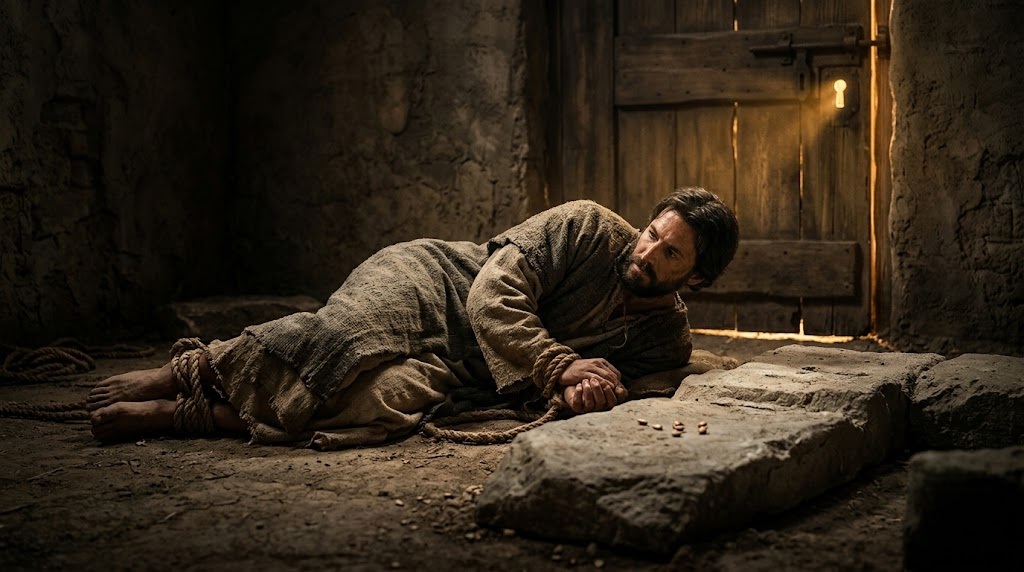
If you've ever read Ezekiel 4, you've probably had the same reaction I did. God tells His prophet to lie bound on his side, unable to turn, for more than a year, as a living sign to a nation that would not listen. Three hundred and ninety days on his left side, bearing the weight of Israel's iniquity, then forty more on his right, bearing Judah's.
"Lie also on your left side, and lay the iniquity of the house of Israel upon it. According to the number of the days that you lie on it, you shall bear their iniquity. For I have laid on you the years of their iniquity, according to the number of the days, three hundred and ninety days; so you shall bear the iniquity of the house of Israel. And when you have completed them, lie again on your right side; then you shall bear the iniquity of the house of Judah forty days. I have laid on you a day for each year." — Ezekiel 4:4-6 (NKJV)
My first thought upon reading that was simple: here's a man doing God's business. Why isn't he exempt? He didn't sin his way into that assignment. He was obedient. And yet God laid something brutally difficult on him anyway.
I've come to believe that question has the answer backward. Ezekiel wasn't given that task despite his faithfulness. He was given it because of it. He was the one man in that moment God could trust to carry it.
1. This Was an Assignment, Not Punishment
Scripture carefully separates discipline from calling, and we need to be just as careful, because collapsing the two will wreck your theology and your peace of mind. Hebrews 12:6 tells us that the Lord disciplines those He loves; that's correction aimed at sin. But that is not what's happening in Ezekiel 4, and it's not what's happening in Job either.
"Then the Lord said to Satan, 'Have you considered My servant Job, that there is none like him on the earth, a blameless and upright man, one who fears God and shuns evil?'" — Job 1:8 (NKJV)
Read that closely. God doesn't point Job out to Satan because Job needs correcting. He points him out because Job is blameless. The suffering that follows isn't a judgment on Job's failure. It's what happens on the other side of God's own commendation.
If you are in something hard right now and your first instinct is to ask what you did wrong, I want you to sit with a harder question first: what if you didn't do anything wrong? What if this is what obedience looks like from the inside?
2. He's the Only One Who Could Carry It
God didn't hand that assignment to just anyone. Ezekiel had spent his life in priestly devotion before God ever called him to prophesy, and it's no accident that the man who asked to bear the nation's iniquity on his own body was one who had already proven he would not flinch from obedience.
We see the same pattern with Hosea, who was told by God to marry a woman who would be unfaithful to him, as a living picture of Israel's unfaithfulness to the Lord (Hosea 1:2). That is not a small ask. It is a lifetime of pain, chosen specifically because Hosea would say yes and remain obedient.
Here's the principle: God does not waste hard assignments on people who won't finish them. If He has put something difficult in your hands, that difficulty is not evidence that you're out of His will. It may be evidence that you're exactly the person He trusts to see it through.
3. Closeness to God Doesn't Shield You. It Positions You.
We tend to assume that the closer we walk with God, the further we get from hardship. Scripture suggests the opposite.
Think about who Peter was in that moment. This is the same man who, earlier in his walk with Jesus, stepped out of a boat and walked on open water at Christ's word. This is the man Jesus would name the rock on which His church would be built. If closeness to the Lord brought exemption from hardship, Peter would be the last man on earth headed for a devastating trial. He had already proven his faith in the most literal way possible, with one foot on the water.
And yet:
"And the Lord said, 'Simon, Simon! Indeed, Satan has asked for you, that he may sift you as wheat. But I have prayed for you, that your faith should not fail; and when you have returned to Me, strengthen your brethren.'" — Luke 22:31-32 (NKJV)
Notice what Jesus doesn't do. He doesn't stop the sifting. He prays Peter through it. The very intimacy Peter had with Christ, the calling Christ had already spoken over him, didn't buy him a pass. If anything, it's the reason he was significant enough for Satan to request him by name. Nearness to Jesus didn't exempt Peter from the trial. It qualified him for it, because what he would carry out of that sifting, humility, a shepherd's heart, and the strength to lead the early church, could only be forged the way it was forged.
The same is true for Jeremiah, a man faithful to a calling that cost him everything and brought him almost nothing but grief in return.
"Then I said, 'I will not make mention of Him, Nor speak anymore in His name.' But His word was in my heart like a burning fire Shut up in my bones; I was weary of holding it back, And I could not." — Jeremiah 20:9 (NKJV)
Even wanting to quit wasn't an option for him. That's not comfort. That's a call. And James tells us plainly why trials like this have any purpose at all.
"My brethren, count it all joy when you fall into various trials, knowing that the testing of your faith produces patience. But let patience have its perfect work, that you may be perfect and complete, lacking nothing." — James 1:2-4 (NKJV)
4. Where I'm Standing Right Now
I'm not writing this from the other side of it. I'm writing it from the middle.
For years now, I've believed God has called me to plant a church, Threshold Assembly. He has opened real doors along the way, including opportunities to preach that I did not manufacture and would not have had access to on my own. I've walked through every one of those doors as they've opened. But the door to step into that calling full time has not yet opened, and I still don't know where He's planting me. In the waiting, life has not been gentle. There has been strain in my family. There has been financial hardship I did not anticipate. There has been spiritual attack that I recognized for exactly what it was. None of that has felt like a blessing. Some days it has felt like the opposite of what a man walking in God's will should be experiencing.
I want to be honest with you about something else, too. More than once, pastors and other believers who had no way of knowing the specifics of what God has shown me about this calling have prophesied details back to me that lined up with what I've already seen in prayer. I can't explain that apart from the Lord confirming what He's already told me privately. So I'm not sitting here wondering if this is real. I know it's real. What I don't have is a timeline, or even a location yet.
I don't have a resolution to offer you here, because I don't have one for myself yet. What I have is a conviction I'm choosing to stand on: God works behind the scenes even when the movement is invisible to me.
"But as for you, you meant evil against me; but God meant it for good, in order to bring it about as it is this day, to save many people alive." — Genesis 50:20 (NKJV)
Joseph said that after years, plural, years of an unjust, unexplained wait that began with betrayal and didn't end until Pharaoh's court, God was moving the entire time. Joseph just couldn't see it from inside the pit or the prison.
"For the vision is yet for an appointed time; But at the end it will speak, and it will not lie. Though it tarries, wait for it; Because it will surely come, It will not tarry." — Habakkuk 2:3 (NKJV)
I hold onto that verse more than I care to admit. The vision doesn't lie. It tarries, but it doesn't lie.
The Call to Action
If God has put something difficult in your hands right now, whether it's a marriage you're staying faithful to in the midst of enormous pain, a ministry door that won't open no matter how long you've been standing at it, or a season of waiting that has cost you more than you expected, I need you to hear this clearly. That difficulty is not proof you've been abandoned. It may be proof you were trusted.
This week, stop asking only "what did I do to deserve this?" Ask instead, "what if this is the assignment, and I am the one He knows can carry it?" Keep walking. Keep obeying. The door hasn't opened for me yet either. I'm still standing at it. But I am not walking away from it, and neither should you.