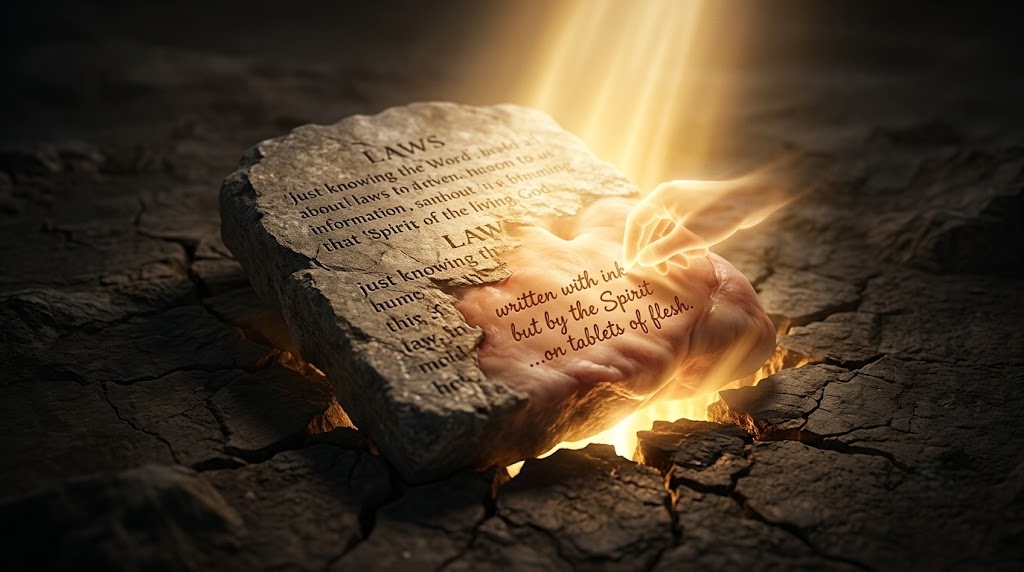
Israel had the words. That is the part we often skip too quickly. God did not leave His people guessing. He gave them the Law at Sinai and was specific about where it was supposed to live.
"And these words which I command you today shall be in your heart." — Deuteronomy 6:6 (NKJV)
Not in a scroll in the corner of the tent. In the heart. They were told to teach it to their children, to talk about it when they sat in their houses, when they walked on the road, when they lay down, and when they rose up (Deuteronomy 6:7). This was not a people who lacked information. They had the words memorized, recited, and bound to their doorposts.
And they still walked away. Over and over, across the pages of the Old Testament, you watch a nation that knew exactly what God required fall right back into the same sin He had already warned them about. Knowing the Law did not stop the golden calf. It did not stop the cycle of idolatry that runs through Judges. It did not stop the divided kingdom from chasing after gods that could not save. They knew the words. The words never got low enough to change what they wanted.
That is the question I have been sitting with in prayer. If knowing is not what changes a person, what is?
God Already Told Us the Problem, and the Fix
Centuries before the New Covenant arrived, God diagnosed exactly what was missing. Through Ezekiel, He said:
"I will give you a new heart and put a new spirit within you; I will take the heart of stone out of your flesh and give you a heart of flesh." — Ezekiel 36:26 (NKJV)
The problem was never a knowledge gap. It was a heart of stone. Stone can have words carved into it, but it does not feel them. Stone does not grieve when it disobeys them.
Then, through Jeremiah, God promised something the Law itself could never do:
"I will put My law in their minds, and write it on their hearts; and I will be their God, and they shall be My people." — Jeremiah 31:33 (NKJV)
Not law delivered to the heart from the outside, but law written into the heart itself, as its new native language. That promise is fulfilled in Christ. Paul told the Corinthian church that they themselves were proof of it:
"...written not with ink but by the Spirit of the living God, not on tablets of stone but on tablets of flesh, that is, of the heart." — 2 Corinthians 3:3 (NKJV)
This is the whole difference between the old and the new covenants. The old covenant handed you a standard and left you to meet it with a heart that could not. The new covenant gives you a new heart and then writes the standard into it.
The Day the Book Became Alive
I read the Bible for years before I understood any of this. I sat with it, read the words, and some of it did not stick. It felt like reading any other book, with information going in and most of it leaking back out by the end of the week. I could tell you what a passage said. I could not have told you why it mattered to the way I lived.
Then God changed my heart from stone to flesh, and the book became alive in a way I cannot fully explain, except to say I noticed it first in what I did and what I said, before I noticed it in what I believed. I became more sensitive to the Spirit of God in the decisions I was making, the small ones nobody else would ever see. Does that mean I became perfect? No. I still sin. We all fall short of the glory of God, every one of us, every day. But something beneath the sinning had changed. I had a deeper, more personal walk with my Savior than I had ever had while reading the same words with a heart that had not yet been made new.
Here is the part I want you to sit with. Now, when I fall, it hurts more. Not because the sin got bigger, but because I can feel that I am grieving Someone who stretched out His arms for me. That ache is not condemnation. It is intimacy. It is the difference between knowing of God and knowing God, between knowing about the Son and actually knowing Him.
Knowledge Was Never the Finish Line
Psalm 119:11 says it plainly:
"Your word I have hidden in my heart, that I might not sin against You." — Psalm 119:11 (NKJV)
Notice what the verse claims stops sin. Not read. Not studied. Hidden. Written in. That is what Solomon was pointing to as well when he told his son:
"Let not mercy and truth forsake you; bind them around your neck, write them on the tablet of your heart." — Proverbs 3:3 (NKJV)
And again:
"Bind them on your fingers; write them on the tablet of your heart." — Proverbs 7:3 (NKJV)
Three different writers, three different centuries, one consistent instruction. The goal was never information. The goal was always internalization.
That is the answer to the question I started with. Knowing the Word did not keep Israel from sin, because knowing was never the mechanism God intended. Writing it on the heart is the mechanism, and only God can do that writing. Ezekiel 36:26 comes before Jeremiah 31:33 for a reason. You need the new heart before the words written there can hold.
How You Actually Get There
This is not a one-time transaction you complete and move past. It is slow and consistent, and most days it will not feel dramatic. You read the Word not to check a box but to give the Spirit material to write with. You ask Him for the heart of flesh before you ask Him for more information. You let conviction do its work instead of numbing it, because that discomfort is often the sound of something being written that was not there before.
It does not happen overnight. I wish I could tell you it did. But I can tell you it is worth it, because on the other side of it is not a man who has arrived, but a man who finally knows the difference between reading a book and carrying a Person.
If you have been reading your Bible faithfully and still feel like nothing is changing, hear me. The problem was never your discipline. Ask God for the new heart first. Let Him do what only He can do, and watch what happens to the words you already know.