I want to tell you about something I am still walking through, and I want to be careful how I tell it.
Something I said was taken the wrong way. It was repeated, reshaped, and by the time it came back around, it no longer resembled what came out of my mouth. I was accused of lying. I was not lying. That is the whole of what I will say about it, because I am not writing to litigate it and I am not asking you to take my side. I am not writing to be believed. Some of you know exactly what this feels like anyway, and you do not need the details to know the shape of it.
What I want to talk about is what I did next, because I think I did what most of us do, and I think I did it for the wrong reason.
I forgave them quickly.
And I want to be clear that forgiving quickly was not my mistake. Scripture does not give us permission to sit on a grudge and let it ripen.
"And be kind to one another, tenderhearted, forgiving one another, even as God in Christ forgave you." — Ephesians 4:32, NKJV
I stand by that. I still forgive them. If you asked me today whether I hold it against them, the honest answer is no.
But here is what I have had to admit to myself. Right behind the forgiveness, I said, "I trust You, Lord," and I said it fast, before I had told Him a single true thing about how much it hurt. I said it the way you slap a bandage over a cut you have not looked at yet. I did not say it out of faith. I said it because I wanted the pain to end.
That is not trust. That is anesthesia with a Bible verse on the label.
Forgiving and Grieving Are Not the Same Work
We have quietly collapsed two different things into one, and it is costing people.
Forgiveness is something you release toward the person who wronged you. It is a decision, often made before the feelings catch up. It is vertical in that God commands it and horizontal in that it lands on another human being.
Lament is something you carry to God about what the wound did to you. It is not aimed at the other person at all. It is you, telling your Father the truth.
You can do both. You can forgive a man completely and still tell God, months later, that it still aches that he thinks you are a liar. Those two things are not in conflict. They are not even in the same room. I have forgiven the people involved in my situation, and it still hurts that they believe I lied. Both of those sentences are true at the same time, and it took me longer than it should have to let them both stand.
What I skipped was not forgiveness. What I skipped was the telling.
David Did Not Skip It
Go read Psalm 13. It is six verses. Count them.
Four of those verses are complaints. Two are trust. The man who wrote it spends two thirds of the psalm in ache before he ever gets to "But I have trusted in Your mercy."
We would have written it the other way around. We would have given the pain one polite verse and then hurried on to five verses of resolution, because that is the version we are comfortable reading and the version we think makes us look faithful. David gave us the opposite, and the Holy Spirit preserved it that way. The proportions are part of the message.
"How long, O LORD? Will You forget me forever? How long will You hide Your face from me? How long shall I take counsel in my soul, having sorrow in my heart daily? How long will my enemy be exalted over me?" — Psalm 13:1-2, NKJV
Four times. "How long." Twice in verse one, twice in verse two. That is not a man who is exaggerating for effect. That is a man who has asked the same question so often that the question itself has become his prayer.
The Hidden Face
"How long will You hide Your face from me?"
I know that one. I have been in seasons when prayer felt like talking into an empty room. When I would open the Word and the page would just be words. When I was doing everything I knew to do and getting nothing back that felt like God.
That is a particular kind of loneliness, and it is worse than the original wound. Being wronged by people is hard. Being wronged by people while heaven seems quiet is something else entirely.
Notice what David does not do. He does not pretend it is not happening. He does not talk himself out of it. He does not write, "I am sure God is here, I just cannot feel Him, and feelings do not matter." That sentence is true, by the way. But David does not lead with it. He leads with the complaint, and he takes it to the only One who can do anything about it.
That is the thing about biblical lament that we miss. It is not unbelief. An unbeliever does not say "How long, O LORD." He just leaves. Lament is faith that is honest. It is a man who still believes God is there and is upset with Him precisely because he believes it.
The Loop and the Lie
Verse two has two halves, and they are completely different problems. I read right over this for years.
"How long shall I take counsel in my soul, having sorrow in my heart daily."
That is the inward loop. It is lying in bed, running the conversation again. It is drafting the perfect explanation you will never get to give. It is taking counsel in your own soul, a polite way of saying you are the only one in the meeting and the meeting never adjourns. I have lived in that loop. Some nights I still do.
"How long will my enemy be exalted over me."
That is the outward injustice. It is watching the false version of you stand up in the room while the true version sits down. It is not that you want them punished. It is that the lie is winning and you cannot make it stop.
If you are in both of those at once, the inward loop and the outward lie, you are not weak and you are not faithless. You are in Psalm 13. There is a place in Scripture with your name on it.
Enlighten My Eyes
"Consider and hear me, O LORD my God; Enlighten my eyes, lest I sleep the sleep of death." — Psalm 13:3, NKJV
I am not going to tell you exactly what David meant by that, because I am not certain anyone can. But I can tell you what it does to me when I read it.
Enlighten my eyes. Give me light again. I am running on nothing. I have lost sleep over this, and some of you reading this have too. You have watched the ceiling at two in the morning, your chest tight over something you did not do. That is not a metaphor for either of us.
David brings his exhaustion to God as a prayer request, not as a confession or a failure. He says, in effect, I am running out. Come do something about it.
You are allowed to pray that. You are allowed to tell God you are tired.
What David Does Not Pray
Here is the part I keep returning to, and I think it is the sharpest verse in the psalm.
"Lest my enemy say, 'I have prevailed against him'; Lest those who trouble me rejoice when I am moved." — Psalm 13:4, NKJV
Read that carefully. He never asks God to destroy them. He does not ask for their ruin, exposure, or humiliation. He asks one thing: do not let the lie be the last word.
That is a completely different prayer from the one most of us actually pray. When I am honest, my flesh wants vindication with an audience. I want the truth to come out, and I want to be standing there when it does. David does not pray that. He prays that the enemy would not get to say, "I prevailed."
And notice who he hands it to. He does not take it back into his own hands.
"Beloved, do not avenge yourselves, but rather give place to wrath; for it is written, 'Vengeance is Mine, I will repay,' says the Lord." — Romans 12:19, NKJV
I will be straight with you. Some days, I want to build my own case. I want to lay out the evidence and make people see it. Twenty-five years of carrying myself a certain way, and a few twisted sentences can put a question mark over all of it. That is hard to leave alone.
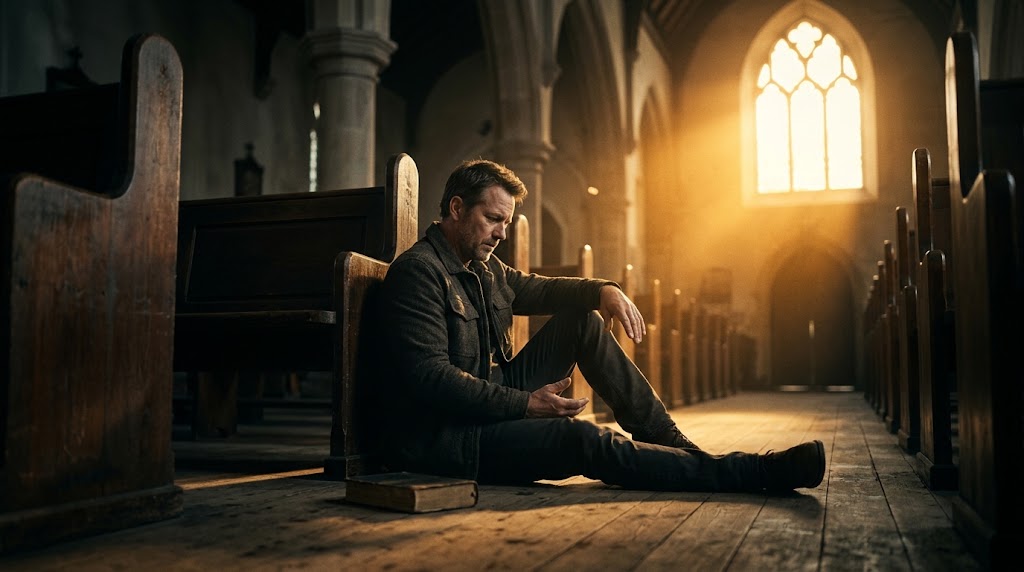
But lament is where I put that down. Lament is me telling God the whole thing, the hurt and the anger and the wanting to be proven right, and then leaving it on the floor in front of Him instead of carrying it back out of the room with me.
He is your friend. Tell Him.
I need you to hear this part more than anything else I have written here.
It is okay to still hurt. It is okay for it to take a while. It is okay to come to God and say, out loud, "I forgave them, and it still hurts."
He is not standing over you with a stopwatch, disappointed that you have not moved on. He is not embarrassed by your grief. Jesus Himself, in the garden, said this:
"My soul is exceedingly sorrowful, even to death. Stay here and watch with Me." — Matthew 26:38, NKJV
And on the cross, He prayed a lament out loud, quoting the opening line of Psalm 22:
"My God, My God, why have You forsaken Me?" — Matthew 27:46, NKJV
If the Son of God lamented, lament is not a failure of faith. It is a language He speaks.
"No longer do I call you servants, for a servant does not know what his master is doing; but I have called you friends." — John 15:15, NKJV
He called you a friend. So talk to Him like one. Not the polished version you would use when praying in front of the congregation. The real one.
"Trust in Him at all times, you people; Pour out your heart before Him; God is a refuge for us." — Psalm 62:8, NKJV
Pour it out. All of it. He already knows, and He will not flinch.
The Turn
Now watch where David lands.
"But I have trusted in Your mercy; My heart shall rejoice in Your salvation. I will sing to the LORD, Because He has dealt bountifully with me." — Psalm 13:5-6, NKJV
Look at the tense. "He has dealt bountifully with me." Past tense. Nothing in David's situation has changed between verses four and five. The enemy is still exalted. The face is still hidden. No answer has arrived.
What changed is that he stopped and remembered.
He is not rejoicing because the problem has resolved. He is rejoicing because of what God has already done, back before this, in the parts of his life that are already settled history. He reached back and found a track record.
That is where I am right now. I do not have a resolution. Nothing has been fixed. I cannot tell you that God cleared my name, because He has not done it yet. What I can tell you is that He has dealt bountifully with me. He pulled me out of a life I had no business surviving. He called me when I was running from Him. He has never once been late, even when I thought He was.
And that mercy does not run out while I wait.
"Through the LORD's mercies we are not consumed, Because His compassions fail not. They are new every morning; Great is Your faithfulness." — Lamentations 3:22-23, NKJV
Sit with where that comes from. That is from the book of Lamentations. It is not from a victory psalm or a mountaintop. It is buried in the middle of the saddest book in the Bible, written by a man watching his city burn. The greatest verse about God's daily mercy comes to us from inside a lament.
You do not have to get out of the grief to reach the mercy. The mercy comes to you in it. New every morning, including the mornings when you wake up and it still hurts.
So Here Is What I Am Asking You To Do
Forgive fast. Do not wait on that one. Release them and mean it.
Then give yourself permission to grieve slow. Take the hurt to God and do not dress it up. Tell Him it is not fair. Tell Him you are tired. Ask Him how long, and ask Him more than once if that is where you are. Do not rush to "I trust You" just to make the feeling stop, because a trust that is really just avoidance will not hold weight when the next thing comes.
And when you have poured it out, do what David did. Do not go looking for a resolution you do not yet have. Go looking backward instead. Find the places He has already been faithful to you, and let those be the ground you stand on while you wait.
He has dealt bountifully with you. Say it even if today is hard. Especially if today is hard.
His mercies are new in the morning. They will be there. So will He.
Pastor Keith